I recently took it into my head to re-read the Hunger Games series. I first encountered them two years ago, whereupon, though in the time I read them I enjoyed them, they became irrelevant in my mind for the most part. The Hunger Games was enjoyable but I found a bit forgettable. Catching Fire was the best of the three, so much that I actually re-read it later in the year. Words cannot describe the loathing I felt for Mockingjay.
One does not simply read the trilogy without getting pulled into the manic fangirling of Team Gale or Team Peeta. Lately, the rad thing to be is Team Katniss. I don't really discuss the books all that much, but I certainly had my own views formulated as I read them and watched the films. Now, two years later, I have thought long and hard about the concepts, the plot, and the relationships between the characters so that I can try to understand what I enjoyed about the series and what turned me off, and I think that the explanation is centered around these three characters: Peeta Mellark, Gale Hawthorne and Katniss Everdeen. The stories are deep, dark and tangible, but the characters weirdly less so. I had to stretch my mind to discover the logic behind their reactions.
Going through the instances in the stories are not enough. I went through the books in an unbiased mindset and psychoanalyzed the character strengths and flaws, decisions, and ordeals that make these three people tick, and hopefully have been able to formulate for you the reasons why I cannot be on Team Gale, Peeta or Katniss.
PEETA
The first knock against Peeta is the fact that he probably has one of the worst names ever given to a male in history. It makes you think of that flimsy, unleavened dough some people keep in the back of the fridge that your Mom makes you substitute for real sandwich bread. Every time I read "Peeta" all I can think is 'come on, Suzanne Collins really couldn't have come up with something a little more manly'? Maybe she wanted to stick with bread names since he's a baker's son, and names like Rye and Buck aren't ideal but they're sure as heck better than Peeta.
Then there comes the weird list of his abilities, which don't line up. Despite his reputation for being very strong (remind me again how lifting bags of flour makes you stronger than an average coal miner? Also, I thought he frosted things, not flour-lifted), he has a penchant for being remarkably weak. As Studio C's musical parody puts it "He throws large weights at whatever he aims/A power so special, never used it in the Games". Again, taking from the same song: "Fog almost killed him - Mag's gave her life for him. Monkey almost killed him - Morphling gave her life for him. Wounds almost killed him - Katniss risked her life for him. A REAL man's not afraid to let women die for him!"
Of course, this is the Hunger Games we're talking about. Chivalry is remarkably dead. Still, for someone who earned an 8 in his private training session, I sure as heck expected to see a lot more action on his part. Instead, we're treated to his nearly dying from Cato's knife, painting himself brown to hide in a riverbank until Katniss finds him, and spending more than half the games lying in a cave sick while Katniss works her butt off to keep him alive. After that, his strength seems to be really gone and he scares away wild animals, nearly kills himself (again) with Nightlock, and then forces Katniss to get injured by mutts when he falls behind because of his leg. Yes, he saved Katniss from the Careers by teaming up with them. Yes, he fought Cato to save her. Two marvelous episodes that were repeated even less in the second Games, because despite his rigorous physical training schedule that he, Katniss and Haymitch all go through before the Quarter Quell, it takes no longer than the gong for Finnick to have to save Peeta from drowning, for Finnick to have to save Peeta from the force field, for Finnick to have to save Peeta from Enobaria, for Finnick to have to save Peeta from the fog (resulting in Mags' death), for Finnick and Katniss to save him from the monkeys (resulting in Morphling's death), and for Finnick and the other rebels to save Katniss from the arena, because in effect it saves Peeta. It's what he wants.
True, it's odd that frosting cakes somehow translates into painting realistic tree bark on your skin. I don't know who would buy a tree-bark cookie. But despite Peeta's complete ineptitude at taking care of himself inside the arena, outside of it he shows that he's more than capable of saving himself and Katniss. It is Haymitch who puts him onto it, but Peeta carries it from there. His gift with words turns the crowd of bloodthirsty Capitol citizens into cheerleaders for Team Twelve. His capability to move people with a look or a touch is a rare gift that he develops and hones for the good of the people around him, especially Katniss. If there is one central thing to be said for Peeta, it is that his love for Katniss is more than romantic. It is what love is supposed to be: self-giving, all encompassing.
Peeta is one of very few morally blameless characters in the Hunger Games series, up there with people like Prim and Hazelle. Peeta is kind. He's no pacifist, but he doesn't kill unless he absolutely has to. He stands up against the Capitol to be "more than a piece in their Games" and he tries so hard not to lose himself in the arena and out. When he is finally forced to by trackerjacker venom, he struggles and fights to find his way back. He is not perfect, of course. He loses his temper with Haymitch, he is jealous of Gale, but he rises above it to be friends with Katniss despite her, in his eyes, cold betrayal at the end of the first book; he puts aside his feelings to help Gale when he is whipped, and to even make some friendly conversation, and he understands the concept of the greater good when it must be used in a morally proper fashion.
All of this being said, I'd say that Peeta's greatest virtue is also his greatest flaw, and that is selflessness when it comes to Katniss. As I re-read these books, I noticed how much he gives of himself for her. He quite literally is willing and nearly does give everything he possesses to her if she thinks she will even want it on a whim. Understandably he is in love, but he conspicuously lacks even self-esteem or, most of the time, an awareness for anything that needs to get done outside of Katniss' need. Sometimes I wonder, would Peeta have given bread to a different girl starving in the rain? Surely he sees many of them every day. It is because the girl is Katniss that he begins his trek of kindness, but as far as we can tell Peeta's real kindness only extends to Katniss herself. He never shows much interest in her family, or his own, or anyone else in District Twelve. He can be polite and nice, but not the Peeta we see around Katniss. Though most likely due to a shyer nature, Peeta's obsession with the girl on fire leaves very little room for anything or anyone else.
Haymitch always tells Peeta the plan - why didn't he tell him the major one in Catching Fire? It is because he knows Peeta's reactions will blow it, just as he knows Katniss' reactions, unless spontaneous, always blow everything. Peeta doesn't have to fake being in love with Katniss. Indeed, he finds numerous opportunities to make her uncomfortable by telling her so, even though he probably doesn't mean to. But the grand-scale plan here is a whole other level, one that Peeta can't handle.
So why am I not Team Peeta? I think that, in the end, of the two choices Katniss would certainly be happier with Peeta because he gives her everything. But I also think that a relationship only based around traumatic experiences and saving each others' lives is not one that will last. The blase and overdone love that could only fool the naive Capitol audience is a one-way ticket to heartbreak. Realistically, going by the way the two characters interact, Peeta represents all things after the reaping. He represents growing up and what that means to Katniss. And here's the catch: when Katniss is with the real Peeta, she is pampered by him. She is pampered by her prep team and pampered by the Capitol. Even in the arena, she gets her full quota of makeout scenes needed for a young adult trilogy. But when he is under the Capitol's poison, Katniss realizes that she can live without him. Despite her claims that she will never recover if he dies in Catching Fire, she has had to come to grips with the realization that death happens and you have to move on. And yes, she wants to save his life. But Peeta acts more like a dog who loves his mistress more than a young man who probably needs something in return. According to the epilogue, they live happily ever after, though damaged. They have each other to heal up. But from what I read, Peeta gave Katniss everything, and Katniss didn't give much in return. I do not think that Peeta understands Katniss. I think he worships her. And Katniss needs him for the hope he brings to her life, but it's such a one-sided relationship on so many different levels that, ultimately, Peeta can do better.
GALE
I am going to be honest: if I had to really pick a team from the options, I would be team Gale, because that is who I would choose if I were Katniss. But I am not Katniss, and Katniss can choose whomever she likes, which is why the whole "team" thing is stupid in the first place.
If Peeta represents life after the reaping, Gale represents childhood. Time and again, over and over, Katniss recalls that the only times she has ever been able to call herself happy are the times she spends with Gale. This is rare for Katniss. Gale is her best friend, and throughout all three books, right up until the last few chapters in Mockingjay, Gale is the one person who she will always run to when Haymitch and Peeta have failed her.
So what happened? In order to divulge Katniss' rejection of Gale for Peeta we have to go through more than parachute bombs, although we will get to that morally questionable moment soon enough.
First, Katniss' point of view. Her father has died, she is starving, and she meets a boy who is a man in her eyes. They bond over hunting, and I think one of the main reasons that Katniss went for Peeta was for the simple explanation that she and Gale are far too alike. Beyond physical features, they are both fatherless. They must grow up faster than any child should to take care of their families, and they both have hot tempers and cool silences when they fight. They find happiness in a way that only best friends can, and it is only after the Games that the friendship begins to corrode. Gale loves Katniss, but he's good at hiding it. Katniss loves Gale but in her constant state of Gale-or-Peeta, she does little more than lead him on hopelessly. In Catching Fire, she has decided. She will be with Gale because Gale means that she can move forward in life and be in a rebellion without having to leave her childhood behind. It is only after the Quarter Quell that she again begins to second-guess her decision.
Her conduct is not fair to herself and certainly not fair to Gale. In Mockingjay, his comparison to himself as the man in The Hanging Tree, "waiting for an answer", is absolutely correct. Katniss continually goes back to Peeta and then expects Gale to be there for her when she gets back. And he always is. But he is tired of waiting for her, and so he moves on to more pressing matters, like the rebellion. He still does not abandon her, however, and Katniss accepts this. Their friendship is a bond that is only broken when Katniss' last shreds of childhood - her sister - are ripped from her.
Gale has absolutely always been there for Katniss, but unlike Peeta, his love is not unconditional. And ultimately, I think it is that which finally causes her to choose the other, and it is because he knows he will not give up everything for her that Gale is able to take that decision from book 1 and swallow it with minimal bitterness. Gale loves Katniss deeply, but he also loves her family. He loves his family, and his coal mining friends, and the people in District 12. He loves his country, he loves the cause of the rebellion and ultimately, he loves the people of Panem. Katniss' growing discontent for his consultations with President Coin and Beetee in Mockingjay are because she is used to someone like Peeta, who will give her everything. Gale, rightly so, has more than one love, and unlike Peeta and certainly unlike Katniss, he will put aside his personal loves for the greater good of the entire nation.
Gale is a soldier. There's no need to go over the fact that he is physically skilled in nearly every way. And a soldier gives his life for his country. A soldier puts aside his own jealousy to help Peeta train for the Quarter Quell, to save him from the Capitol, to become his friend when he doesn't have Katniss anymore. And while a soldier and an Amazon like Katniss can certainly be best friends over mutual respect and even love, a romantic bond is not one that will last.
Gale's awkward ending is one, I think, that had more than one person confused, not least of all because Katniss' anger towards him is unjustified. Gale would never have authorized the use of parachute bombs on children, or on rebel medics. He may have come up with the idea, which on it's own is morally debatable, but it is clear from the start that he likes kids, especially Rory, Vick, Posy and Primrose. He doesn't let his siblings take tesserae and is unable to talk about it when starvation forces Rory to. He wants to see Prim's face when Katniss brings her the goat, and overall is a love of innocence and childhood, probably because he never got much of one himself. It is even confirmed that he didn't know if the bombs used were his. For all we know, he never meant to use them at all.
It seems to me that Suzanne Collins was getting far too much of a positive reaction to Gale when everyone was supposed to like Peeta more, so she tried to drop the literal bombshell of his lust for war. Unfortunately she had already set him up as a character, and psychologically his actions don't follow the personality she had already given him, which is why I can endeavor to explain all of this away.
Gale is not listed in the morally blameless because of his actions in the war. He is up there with Haymitch, Finnick and Cinna in the category of "best characters who have made some bad decisions". He designs weapons of cruel destruction, or "death traps" that will ensure bloody, if quick, ends to the war. But his seeming flippancy for human life and desire for revenge are, I think, overrated. For readers like us, it is so easy to point out the faults. Looking back on the atom bomb, it is also too simple to condemn. The atom bomb was wrong. Gale's traps are wrong. But in the heat of the moment, when someone has to make the difficult decisions, the end is that, well, someone does have to make those decisions. Gale is a boy who had his father and all comfort ripped from him at a young age, who had to grow up in harsh conditions and provide for his family, watching everyone he loved suffer. Even a dispirited man would want to do something for the cause, and Gale has more than enough reason to want justice. Justice, not revenge. It is not personal, it is for the whole country of Panem. The scene in the Nut with the fighting miners only confirms that Gale is right. Katniss has the bullet hole to prove it. But from the beginning, with his rants against the Capitol, Gale knew what needed to happen. He isn't content to lay down and let everyone walk over him the way Katniss and Peeta are, because he recognizes the need for everyone else who cannot fight for themselves. It is why he is prepared to run away, but when an actual chance of rebellion ignites, he must stay and help it, sacrificing almost definite happiness with Katniss. As a result, he saves 800 of District 12's citizens. Time and again, over and over, it can only be admitted that, about the war in general, Gale is right and Katniss is wrong. Coin is even right sometimes. War is never easy, and war is certainly never won by people like Katniss, who want to run off and find their own piece of perfect apart from the rest of the world. It's won by people like Gale, even if he has two decisions and both of them end in bloodshed. Remember that Katniss also began to develop a killer streak in the heat of the moment, both in the arena and when she was on missions with her squad. Gale is the Ender Wiggin of the Hunger Games, though regrettably far less complex and fascinating. He doesn't just win the battle, he wins the war, and he wins so thoroughly that the Capitol can't rise back up.
I am not endorsing Gale's bombs, or his disregard for human life. But Gale, unlike Katniss, has not suffered the arena. And Gale understands and accepts that in war, people die. He does not want to kill innocent people. Few people do. But he understands that collateral damage happens, and sometimes, you do have to think about the greater good. He just sometimes goes about it in the wrong way.
Katniss is bitter by the end of Mockingjay, and also slightly insane. Her friendship with Gale is broken, not, I think, because of the parachute bombs, because she knows that they were not his fault, at least not directly. They are Coin's. It is broken because seeing Gale reminds her that she can't go back. She can't go back to being innocent, and young, and happy in the way she was before. Without him, even with Peeta, Katniss misses what he brought to her life. It is why she waits for him by the rock, even though she knows he won't come because he is in District 2. It is why she is bitter about his job and assumes he has another girlfriend, because it is so much easier to be angry at and blame the ones we love rather than forgive them for what they cannot control. The fire of hatred and rage she says burn in him are the effects of hatred and rage at herself, turned inward and soothed only by Peeta's constant self-giving company. Katniss wants Gale back as surely as he wants her. Not in a romantic way, but in friendship. But as we know, Katniss is not the forgiving type.
Never, never can we say that Gale abandoned Katniss. It takes one cursory read to see that what happened was not abandonment, it was resignation. Gale understands Katniss better than anyone, even Haymitch, and he knows that she can never really be content with life when he is there because of the reasons described above. He always knew it, but he clearly also always hoped it would be different. When the final blows begin to fall, he recognizes that the odds were never in his favor, tells her goodbye and leaves before they both wish too much that he will stay. He can live without Katniss, and Katniss can live without him. They were always self-sufficient that way. Life will simply be more bittersweet than it was before.
KATNISS
I'm not sure that people are going to like what I say about the girl in fire. She has been labeled as a great feminist role model (who spends half her time getting rescued by boys) and in general as a heroine that people can look up to.
Here is exactly why I think that Katniss Everdeen is a bad role model: as a character, she has moments of real courage. She has times where she is selfless and giving and loving. She is strong and nearly self-sufficient. She is also overly sensitive, unforgiving, rash, temperamental, and ultimately one of the most selfish characters in the book. In short, the way that she reacts to her terrible situations is almost exactly how we would react. One of the things that makes Katniss so appealing is the level of relatability that she gives the readers. If my mother went into a coma-like state, leaving her grieving children to starve, I would be wary and find it difficult to forgive. I might get up the courage to take my sister's place in the Hunger Games, but I would be moody, scared and sensitive. I wouldn't want to be any crummy District 13's Mockingjay. I would feel betrayed by Haymitch in Catching Fire. I would probably want to kill President Snow, and I would feel haunted by those I had already killed.
But what makes a role model isn't that you can relate to them. It's watching them overcome their hardships and come out a better person on the other side. It's why we idolize Harry Potter and Aragorn. Not because they abolished their fear, but because they overcame it, and their other shortcomings. Katniss starts and ends the same way she always was. She doesn't understand the effect she has as a leader of the rebellion, and ignored it when people try to tell her. She puts her own needs before everyone else's. Absolutely anything she does it motivated by her need to save herself or someone she loves. Not the people of Panem. Not the innocent of District 13. If it doesn't help save Peeta, she won't do it, no matter how much good it gives other people. If it didn't include a benefit for her, it must have been a bad plan. If Haymitch doesn't tell her the plan, even though she has so obviously shown herself incapable of handling something of that precision and magnitude, she is once again a martyr. She leads on Gale and Peeta because of her own need for physical comfort. She can condemn Gale and the Capitol for their ruthlessness when she kills an innocent Capitol woman just for being in her way. She has no hope in humanity and hides herself away, an empty shell to slowly fill back up from Peeta's love. She is motivated to kill Snow by revenge, not justice. She can be right. Her ultimate act of sacrifice in killing Coin to end the Hunger Games for good is a redeeming end that is unfortunately overshadowed by the misery of the series in general. And in the end, she has no character development. All that comes out differently is that she is a colder killer and an emptier person. Which is not bad writing. It shows the horrible reality of the situation. It shows that something like this only ends in damaged people where no one comes out better. But never does it give a good reason besides her moments of courage and disregard for her own life that can be construed as selflessness for why she should be anyone's role model.
So in the end, I am not Team Katniss because Katniss does not deserve either Gale or Peeta. It sounds harsh but I think it's the truth. She went from a good, but not great person, to an okay person. It doesn't detract from her performance or the way Collins wrote her, it only detracts from the character herself. Perhaps the best way to end her section is with a little humor:
Studio C's Katniss' Song
To wrap up, I think I enjoyed the books more this time around, and I've always liked the movies. The style is a little too casual for me, with too many grammar mistakes and not enough depth, and there is too much focus on the romance rather than the actual problems. It's certainly no 1984 or Brave New World. It's not even Harry Potter. But for a YA series, it sure beats Maze Runner and Divergent. The concept is really very good. It is logical and follows the sick need for violence in gladiatorial Rome (notice all the Capitol citizens have Roman names) and I could see, in the distant future, the USA getting to a place like that. The plot is quick-moving, and characters interesting and realistic, even if I find it a little bit of a stretch that Panem stood the child slaughter for 75 years. And what happened to the rest of the earth? But these are small details.
So bye for now, and may the odds be ever in your favor!
-Rhian
Thursday, April 2, 2015

Wednesday, February 11, 2015
On a Guest Writer
I don't usually publish my posts anymore, but due to prompting from several unnamed friends, I have decided to re-publish a charming little article I found once upon a time. I assure you I have the writer's full permission. I also assure you that I do not look upon February 14th in this way whatsoever. It is, in my opinion, a sweet holiday where flowers go to the forefront of peoples' minds, which can only be a plus. Enjoy.
The Modern Cynic's Guide To:
HAPPY VALENTINE'S DAY
When you ask someone what they do to celebrate this romantic day, there is a spectrum of answers in varying degrees of joy or bitterness or pretended indifference. Responses go from the ecstatic love of a girl on a date to the icy cynic who holes up in the basement and spits on the color pink.
Today, let's get to the bottom of the mystery. What attracts us about Valentine's Day? What repels us? Are we really oblivious to its charms and grievances?
Traditionally, the Latin name "Valentine" means "strong". How did this become a love fest? Legend has it that the feast of St. Valentine landed on February 14th, the same day that Roman virgins placed their names in an urn for young single men to draw out.
A-ha! So speed dating is an acceptable way to spend Single's Awareness Day!
Spend the day however you wish, of course, as aware of your singleness as you like. But as to the day itself, what are its perks?
Girls like pink. They like flowers and candy and shiny, cheap boxes and diamond rings and French restaurants and romance. To have a day devoted to these things is cotton-candy heavenly!
Bad metaphor.
But girls want someone to spoil them, and even if the drawbacks outweigh the benefits, guys usually want an excuse to pamper. What better time than a day devoted to romantic love?
But the consequences? Consumerism. Hype. Expectancy. And what if (scream the masses) I have no significant other? What about me? Where's my love? Do I have to spend this love fest with naught but my onesie and some lonely ice cream?
Understandable bitterness: the message of love and a need for romance on this day seeps through our bones and reminds us how alone we are. Ergo the hatred, or the supposed nonchalance.
Can we ignore it? Is it possible to not think of what we have - or so conspicuously lack - on this fluffy pink day of chocolaty lace?
Due to those very attributes that make it such an undesirable "holiday", we cannot. And that is why we lap it up like dogs; because nothing says "feel sorry for me" in modern America like celebrating alone. And we just love giving ourselves a pity party at every opportunity. We love snooping into everyone else's love life. And we love another reason to spend that dough and get fat. God bless the USA.
-By Mamie Peterson
The Modern Cynic's Guide To:
HAPPY VALENTINE'S DAY
When you ask someone what they do to celebrate this romantic day, there is a spectrum of answers in varying degrees of joy or bitterness or pretended indifference. Responses go from the ecstatic love of a girl on a date to the icy cynic who holes up in the basement and spits on the color pink.
Today, let's get to the bottom of the mystery. What attracts us about Valentine's Day? What repels us? Are we really oblivious to its charms and grievances?
Traditionally, the Latin name "Valentine" means "strong". How did this become a love fest? Legend has it that the feast of St. Valentine landed on February 14th, the same day that Roman virgins placed their names in an urn for young single men to draw out.
A-ha! So speed dating is an acceptable way to spend Single's Awareness Day!
Spend the day however you wish, of course, as aware of your singleness as you like. But as to the day itself, what are its perks?
Girls like pink. They like flowers and candy and shiny, cheap boxes and diamond rings and French restaurants and romance. To have a day devoted to these things is cotton-candy heavenly!
Bad metaphor.
But girls want someone to spoil them, and even if the drawbacks outweigh the benefits, guys usually want an excuse to pamper. What better time than a day devoted to romantic love?
But the consequences? Consumerism. Hype. Expectancy. And what if (scream the masses) I have no significant other? What about me? Where's my love? Do I have to spend this love fest with naught but my onesie and some lonely ice cream?
Understandable bitterness: the message of love and a need for romance on this day seeps through our bones and reminds us how alone we are. Ergo the hatred, or the supposed nonchalance.
Can we ignore it? Is it possible to not think of what we have - or so conspicuously lack - on this fluffy pink day of chocolaty lace?
Due to those very attributes that make it such an undesirable "holiday", we cannot. And that is why we lap it up like dogs; because nothing says "feel sorry for me" in modern America like celebrating alone. And we just love giving ourselves a pity party at every opportunity. We love snooping into everyone else's love life. And we love another reason to spend that dough and get fat. God bless the USA.
-By Mamie Peterson
Wednesday, December 17, 2014
To a member of Team Adam
Mr.Matt McAndrew,
I suppose that I didn't pay much attention to you in the beginning. My favorite was Ricky Manning, not least of all because I agree with Adam and he looks like Joaquin Phoenix.
I noticed that you sang Drops of Jupiter for your knockout, one of my all-time favorite songs, but since they didn't show it I didn't even learn your name.
Come top 20 eliminations, Ricky was gone. I needed a knew favorite. I am a fan of the Beach Boys, but I had never heard God Only Knows. I can honestly say that, though I looked it up after the show, I prefer your version and it continues to be my favorite performance of yours.
It wasn't long before I was hoping you would get through to the finals, because not a Monday or Tuesday night went by that I didn't want to hear you perform.
Your versatility was what really drew me in. I was positive that you could do anything: and you did. Through The Beach Boys, Train, Ed Sheeran, U2, and more, I only became more convinced that you would win. During finals week at my school I listened to the Blower's Daughter on replay because it was the only song that would calm me down.
You sang Bono! No one does that - but you did. Your voice is so pure that it is enough to make someone cry, to make them smile, to make them angry or want to jump up and go on an adventure, and there wasn't a soul in my family that wasn't blown away by your talent.
I want you to know that, hundreds of miles away in a little town in Michigan, there was a sixteen year old girl who has watched this show for years, who watched you get second place, and who knows that if there was ever someone on that show who deserved to win a record deal, it was you.
I watched you chart number one on itunes with a song that you yourself wrote, I watched you go up against two teammates with phenomenal voices and a man with the power to command the stage who ended up beating you, and I watched Adam take to you like I've never seen him take to one of his artists.
I wanted to watch you win.
There was no other contestant on that show whose album I would buy. When you open your mouth, you live every note and vicariously through you, so does everyone else. Adam never said a truer word than after your Somewhere Over the Rainbow performance: the whole world stopped spinning, just for a moment, to listen to something so pure and bittersweet.
So here is what I have to say to you: This morning I woke up and I prayed that you would have a better life than you ever imagined. I prayed that you would never accept America's decision that you were second best, and I prayed that I would get to hear your voice on a CD sometime soon.
A lot of talented people come and go on that show. I've heard Adam give promises that so far I've never seen come to fruition, but from that show there is no voice I'd rather hear than yours.
I prayed that, if Adam really cares, you'll get a check mark in that box.
I suppose that I didn't pay much attention to you in the beginning. My favorite was Ricky Manning, not least of all because I agree with Adam and he looks like Joaquin Phoenix.
I noticed that you sang Drops of Jupiter for your knockout, one of my all-time favorite songs, but since they didn't show it I didn't even learn your name.
Come top 20 eliminations, Ricky was gone. I needed a knew favorite. I am a fan of the Beach Boys, but I had never heard God Only Knows. I can honestly say that, though I looked it up after the show, I prefer your version and it continues to be my favorite performance of yours.
It wasn't long before I was hoping you would get through to the finals, because not a Monday or Tuesday night went by that I didn't want to hear you perform.
Your versatility was what really drew me in. I was positive that you could do anything: and you did. Through The Beach Boys, Train, Ed Sheeran, U2, and more, I only became more convinced that you would win. During finals week at my school I listened to the Blower's Daughter on replay because it was the only song that would calm me down.
You sang Bono! No one does that - but you did. Your voice is so pure that it is enough to make someone cry, to make them smile, to make them angry or want to jump up and go on an adventure, and there wasn't a soul in my family that wasn't blown away by your talent.
I want you to know that, hundreds of miles away in a little town in Michigan, there was a sixteen year old girl who has watched this show for years, who watched you get second place, and who knows that if there was ever someone on that show who deserved to win a record deal, it was you.
I watched you chart number one on itunes with a song that you yourself wrote, I watched you go up against two teammates with phenomenal voices and a man with the power to command the stage who ended up beating you, and I watched Adam take to you like I've never seen him take to one of his artists.
I wanted to watch you win.
There was no other contestant on that show whose album I would buy. When you open your mouth, you live every note and vicariously through you, so does everyone else. Adam never said a truer word than after your Somewhere Over the Rainbow performance: the whole world stopped spinning, just for a moment, to listen to something so pure and bittersweet.
So here is what I have to say to you: This morning I woke up and I prayed that you would have a better life than you ever imagined. I prayed that you would never accept America's decision that you were second best, and I prayed that I would get to hear your voice on a CD sometime soon.
A lot of talented people come and go on that show. I've heard Adam give promises that so far I've never seen come to fruition, but from that show there is no voice I'd rather hear than yours.
I prayed that, if Adam really cares, you'll get a check mark in that box.
Saturday, December 13, 2014
To the Talented Mr. Ridley
When I first saw the trailer for Exodus: Gods and Kings, I thought that, perhaps, this would be a film that told the true story of the Exodus. It looks to be a fantastic masterpiece, with stunning visual effects, impressive performances and most of all a movie that would bring the awesome power of God to the big screen,
We get it. Its hard to portray a Bible story to great magnitude. But you seem to have forgotten that it was a Bible story you were portraying in the first place.
You did well on some points. The detail and majesty of the sets and costumes overwhelmed me with the feeling of Ancient Egypt. Ramses was the best I've seen in a while; believable and pitiable, but also as easy to hate as the proud king in the Old Testament. You slipped up a bit historically - Ramses the Conqueror, he was called, and you made him look like an incapable military commander - but its simple to overlook that. His sweet family dynamic caused me to cry like a baby when the tenth plague came to fruition, and his chilling scene of "I am God" was one of the more memorable points in the film.
Speaking of the plagues, you did them well too. I felt heart-wrenching pity for the Egyptians; a line in the best Moses movie ever made came to mind as I watched the people suffering from the boils:
We get it. Its hard to portray a Bible story to great magnitude. But you seem to have forgotten that it was a Bible story you were portraying in the first place.
You did well on some points. The detail and majesty of the sets and costumes overwhelmed me with the feeling of Ancient Egypt. Ramses was the best I've seen in a while; believable and pitiable, but also as easy to hate as the proud king in the Old Testament. You slipped up a bit historically - Ramses the Conqueror, he was called, and you made him look like an incapable military commander - but its simple to overlook that. His sweet family dynamic caused me to cry like a baby when the tenth plague came to fruition, and his chilling scene of "I am God" was one of the more memorable points in the film.
Speaking of the plagues, you did them well too. I felt heart-wrenching pity for the Egyptians; a line in the best Moses movie ever made came to mind as I watched the people suffering from the boils:
All this pain and devastation, how it tortures me inside
All the innocent who suffer from your stubbornness and pride!
Truth be told, I was tempted to fall on my knees in the face of the might power of God portrayed so stunningly. There were, however, drawbacks. One would think that if crocodiles eating people had been the cause for the Nile turning to blood, it would have been mentioned in the Bible. The explanation of natural clay was starting to look very appealing after such a gruesome slaughter. Nevertheless, I was impressed by how you pulled off the plagues.
These high points being explained, I have a few questions for you: When was the last time you opened a Bible and actually read the story of the Exodus? With such rich content, did you really need to leave so much out and add so much in? Don't you know that the fundamental purpose of the Bible is to explain that God became human in the New Testament? Are you really happy with the way that you portrayed Him? With the way that you portrayed Moses? What about Miriam and Aaron?
Though I am a Catholic who is familiar with the story, this is not a critique of your theological methods. I am going to be pointing out only what is clearly said in the Bible.
Let's tackle these questions. Either you've never read the book of Exodus or you chose to ignore some of the most fundamental basics. You mixed up the motives for the slaughter of the innocents in the gospels and the motive for the Egyptians. You just had to drag in prophecy, decades before the prophets even existed. Miriam's mother raised Moses, not Miriam herself. She never became Egyptian, and she most certainly did not stay in the city while her people left. You ignored one of the most important people in Moses' life, and instead gave us Joshua. While this was an interesting tidbit, in the original books Joshua is not even mentioned until Moses is already dead. You also gave Aaron a wee role as Moses' left hand man. What you (and for some reason most other directors of Moses films) have also neglected to tell is the story of Moses' inability to "speak well" and God tasking Aaron to be the spokesperson to Ramses. It is such a rich detail that could bring Aaron's character into the light. Instead, you have chosen to let Moses come into greater character detail, which really didn't help the character at all.
Since when did Moses abandoned his family so that he could go to Egypt and perhaps never see them again? And going by that standard, since when did he blame God for abandoning them, and since when did God throw the blame right back at Moses? It all could have been avoided in this very simple Bible verse: Exodus chapter 4 verse 20: "And Moses took his wife and sons and set them upon an ass, and he returned to the land of Egypt; and Moses took the rod of God in his hand." Did you just want the drama of it all? You could have spent longer on their courtship if more romance was what you wanted. As my friends and I talked after seeing the movie, one of them mentioned the scene by saying "and suddenly, four seconds later he's marrying Zipporah."
Speaking of time passing quickly and Moses' staff, here is the list of main things you removed:
- The Staff turning into a snake and devouring the snakes of the high priests
- Moses raising his staff to perform miracles
-Aaron's part (already discussed)
- The pillars of cloud and fire to lead the Israelites
- The pillar of fire attacking the Egyptians
- The songs of praise of the Israelite women (led by the neglected Miriam)
-Moses killing the Egyptian slave driver (the original reason he got exiled, by the way)
Such amazing visuals these could have made! The richness that they could have added to the story! Instead, you added parts that were unnecessary and most of which were certainly not in the Bible:
-Ramses almost cutting off Miriam's arm
-A prophecy about a leader that tensed things in a totally random fight with the Hittites
-Guerrilla Warfare and Sabotage
-Hanging of families
-Moses hiding
-Half of Ramses' army falling off of a cliff
-Moses getting lost
-The significance of an Egyptian sword; the significance of which no one understood
- The Golden Calf, the Ten Commandments and Moses dying
- Pessimistic Moses
Presumably the reason for the Israelites' attempts at warfare was because you just wanted to blow something up. Shoving 40 years of wandering without explaining it into the last five minutes of an already too-long movie, was that your idea of finishing the story? It would have done far better to have it end with Ramses' skeptical, forlorn murmur of "Ramses the Great?", seeing as Ramses was the best character anyway. Instead, we got treated to Moses bringing up a problem of disunity between tribes, a problem that didn't even come to fruition until circa 922, after the death of Solomon, and a very grouchy paraphrase of "if we ever get to the promised land", a sentence that you did not care to explain led to 40 years in the desert. Perhaps you thought we already knew the story. I think it was just more obvious that you didn't. I was actually surprised that you added the burning bush, because it had taken so long for it to appear. Not, however, so surprised and more importantly deeply annoyed at the way that you brought God into it.
We understand, Mr. Scott. Its a great challenge to portray God. You probably didn't want to do just a voice out of nowhere (though that is how it is in the Bible) because you wanted to be different. Understandable, but nonetheless vastly preferable to a bratty 8 year old with a British accent, building rock castles and grinning devilishly. You portrayed God as a child who 1) Doesn't seem to know who Moses is and talks to him as a mentor to his student at best, like an old friend at worst 2) Likes to serve tea Chinese guru fashion and acts like a human, something that, as I already mentioned, doesn't happen until the New Testament 3) Is a kid in the first place - when God appears in the Old Testament, they say how he appears. A pot, a flame, a voice. But never as a child. 4) Someone without love who wanted revenge on the Egyptians. A child killer, just as Ramses said.
I have heard that the child was meant to be represented as the angel of the Lord that is spoken about in the Bible, a representative of God, and that Moses proves this by calling him messenger. The only difference between God and his messenger, however, is the person who says the lines. The word are still God's, the intent is still God's, and they still come from the mouth of a child you can't act. It only throws the character of God deeper into a pit by having such a silly, practically demonic little cretin at his service.
I have heard that the child was meant to be represented as the angel of the Lord that is spoken about in the Bible, a representative of God, and that Moses proves this by calling him messenger. The only difference between God and his messenger, however, is the person who says the lines. The word are still God's, the intent is still God's, and they still come from the mouth of a child you can't act. It only throws the character of God deeper into a pit by having such a silly, practically demonic little cretin at his service.
I won't get into theology with you. Maybe you believe that God is cruel and merciless and a very rude little boy. Maybe you wanted to pander to wider crowds by combining Buddha, God and Eustace Clarence Scrubb. But here is what I have to say:
You decided that you wanted to make a movie about the Exodus. And when you do that, please, make a movie about the Exodus. Few people like to see any book adaption messed up, but no one wants to see it in a Bible story unless they are anti-Christianity or never read the book. I'm sorry if the story you chose is a Christian one, but I think that this movie is an obvious attempt to show off your plague of locusts ability rather than bringing one of the most timeless stories to life in this modern era. I should have known as soon as I saw the marker BCE after that date. You put in a few Christian elements instead of revolving the story around its core.
I won't go into the script, and how everyone talked like 1800's British people. I'll try to ignore all of the minor things you ignored, like Zipporah's circumcision of the boy and how she obviously has stronger faith than one she would give up to keep Moses. I'll forget that I caught several repeats of Gladiator, a brilliant movie. Its a shame you couldn't have done better with this, it truly is. You are a talented man and you could have made this wonderful, and not just for Christians.
Here is my advice to you: Next time you decide to make a Christian movie, read the source material.
Monday, November 10, 2014
Character Evaluations: Ferb
What kind of a name is Ferb, right?
Ok, try not to jump down my throat on this one. Yes I'm writing a post on a character, which I've never done before. Yes I plan to do it more often. Yes I've chosen to do a children's character. Yes, he's cartoon. Yes, his name really is Ferb. No, I'm not sorry.
Though perhaps not what we mature "older people" would call 'deep', I've chosen to do Ferb because I'm lying sick in bed, bored because Netflix ran out of good movies and wishing I could watch P&F with Genna, because I feel like an idiot being 16 and watching it by myself.
I have also chosen to do Ferb because, out of the characters in this marvelously animated TV show, Ferb is the one with what I think can be called character depth. For a kids show, they all have a remarkable range of emotions, but I think that Ferb's lack of this exact quality speaks volumes, which is saying something because he usually says an average of 8-20 words per 22 minutes.
So how is this depth, you ask? Why should Ferb be the interesting one when Phineas is the one who does just about everything!!! Why ever prefer Ferb to Phineas? After all, Phineas is a good, all american boy who's got a great mind, creativity, a knack for building things, a big heart and a pretty good singing voice too. And Isabella likes him, that's a good sign, right?
While Phineas is very likable indeed, I seemed to gravitate towards Ferb ever since I saw my first episode. Maybe it was because he has a British accent. But it's time to evaluate. No need to stick with me since I'm not posting this anyway.
#1: Appearance:

Ferb has, as seen above, green hair, mismatched eyes, a huge nose, prominent upper lip and a yellow dress shirt with high waisted purple pants. Yeah, he does look a little ridiculous if you look too hard, so try not to. The thing about Ferb, is that he changes his clothes a lot. No more than Phineas, admittedly, but somehow, Phineas always remains looking like a the boy he is. Ferb seems to pull off just about anything, even if Phineas looks even worse in whatever costume they've donned for the episode.


Let's just admit how fantastic he looks with black hair in that last pic, hm?
So Ferb is basically a good looking guy (as the TV show goes - I can hear you now 'If that's good looking, I don't want to see what the ugly ones look like'. And you don't. But don't you think he looks pretty good in that white tux?)
Now we've got the shallow part over with, on to bigger and better!

Just kidding. His eyebrows are killing me.
Aaaaaaand one more for my sake:


Ok, try not to jump down my throat on this one. Yes I'm writing a post on a character, which I've never done before. Yes I plan to do it more often. Yes I've chosen to do a children's character. Yes, he's cartoon. Yes, his name really is Ferb. No, I'm not sorry.
Though perhaps not what we mature "older people" would call 'deep', I've chosen to do Ferb because I'm lying sick in bed, bored because Netflix ran out of good movies and wishing I could watch P&F with Genna, because I feel like an idiot being 16 and watching it by myself.
I have also chosen to do Ferb because, out of the characters in this marvelously animated TV show, Ferb is the one with what I think can be called character depth. For a kids show, they all have a remarkable range of emotions, but I think that Ferb's lack of this exact quality speaks volumes, which is saying something because he usually says an average of 8-20 words per 22 minutes.
So how is this depth, you ask? Why should Ferb be the interesting one when Phineas is the one who does just about everything!!! Why ever prefer Ferb to Phineas? After all, Phineas is a good, all american boy who's got a great mind, creativity, a knack for building things, a big heart and a pretty good singing voice too. And Isabella likes him, that's a good sign, right?
While Phineas is very likable indeed, I seemed to gravitate towards Ferb ever since I saw my first episode. Maybe it was because he has a British accent. But it's time to evaluate. No need to stick with me since I'm not posting this anyway.
#1: Appearance:
Ferb has, as seen above, green hair, mismatched eyes, a huge nose, prominent upper lip and a yellow dress shirt with high waisted purple pants. Yeah, he does look a little ridiculous if you look too hard, so try not to. The thing about Ferb, is that he changes his clothes a lot. No more than Phineas, admittedly, but somehow, Phineas always remains looking like a the boy he is. Ferb seems to pull off just about anything, even if Phineas looks even worse in whatever costume they've donned for the episode.
Let's just admit how fantastic he looks with black hair in that last pic, hm?
So Ferb is basically a good looking guy (as the TV show goes - I can hear you now 'If that's good looking, I don't want to see what the ugly ones look like'. And you don't. But don't you think he looks pretty good in that white tux?)
Now we've got the shallow part over with, on to bigger and better!
Just kidding. His eyebrows are killing me.
Aaaaaaand one more for my sake:
And yeah. Just because.
Now for real, I promise! Let's have a look at his character now, by studying what he does in the series.
#2 Character
. As opposed to Phineas, who babbles on and on and on about basically anything you'll give him cause to talk about, Ferb doesn't speak unless he has something very important to say, and when he does it is usually either a deep insight into life or a trivia fact that shows off how wicked smart he is. Ferb, as described by Phineas in the very first episode, is "more of a man of action".
And it seems so, because while Phineas' creativity and leadership directs his stepbrother and the Fireside girls what to do, it becomes noticeable after not too many episodes that Ferb does all of the heavy lifting. You can say that Phineas helps, of course, because he does, but Ferb is always the one to man the machines, press the button, carry the supplies to be ready at a moments notice. He runs errands for Phineas and built the rollercoaster in the backyard almost singlehandedly while Phineas...you know, I don't even remember what Phineas was doing. But he wasn't exactly helping with the actual building. Ferb is handy with tools, it is clear, and is a master of construction. The reason that the show is called "Phineas and Ferb" and not just "Phineas" is because, as shaded to the background as Ferb may be, he is necessary to complete the tasks because he is just so good at what he does.
Ferb is not an emotional person by nature, probably because he's British. He rarely smiles or reveals any other facial expression, but when he does you know he really IS feeling it. One of the reasons I like Ferb is for that very reason: while the other characters are your average American show-your-feelings-to-the-world, Ferb much more closely resembles his pet Perry the Platypus, who tends to roll his eyes or cock an eyebrow as opposed to shouting or using words when angry. Ferb seems to have a very even temperament, because even when Phineas is angry, (Phineas has shouted at both Candace and Perry, Mission Marvel and Across the 2nd Dimension, and probably more but I can't remember) Ferb seems to regain control. He ignores Candace's plea to him rather than shouts at her (though this could be merely because he is focused on fixing a superhero suit), and actually tries to restrain Phineas' anger at Perry. Ferb feels he has the best of both worlds as a British-American (My Fair Goalie) and is happy with his life, even if he doesn't show it on his face. He never gets angry when Phineas' absentmindedness physically harms him on two occasions, either. The only time two times Ferb is shown to get irritated are when Phineas and Isabella give up the search for their lost lizard (which prompts Ferb's longest line, a shortened rendition of a Henry V speech) and in "The Beak" where Phineas and Isabella congratulate each other on their bravery and waltz off in the parade, leaving Ferb, who manned the legs of the suit and eventually the whole suit when Phineas goes AWOL to save Isabella, with an annoyed "Um, hello?! Entire lower half of an amazing superhero here!" No one hears him, however, and he shrugs it off with a "I guess there's no glory in thighs" and follows in the wake of the parade.
Ferb's maturity seems to outrank Phineas', which points to him probably being a little bit older (probably between 10 or 12). Indeed, while Phineas seems blissfully ignorant of Isabella's crush on him, Ferb knows and sees all and, though sometimes a bit ignorant himself when tagging along on what Isabella wanted to be a sort of date, is generally very kind to Isabella and good friends with her; walking away to leave the two alone, helps plan a nice evening for the two on Isabella's birthday, listens to her woe and lends her a hanky. Isabella, to my chagrin, rarely even says 'hi' to Ferb, and I am impressed by Ferb's continuing generosity to her when she ignores him for the most part. Ferb also gives advice to a grumpy Vanessa about love that mends her relationship with her father, and saves Candace several times. He lets Baljeet win a video game so that he won't feel bad, and generally supports helping anyone that needs him and his stepbrother.
Speaking of Vanessa, Ferb is definitely human since he has a crush on her and risks much to help her with little things. Vanessa, for reasons unbeknownst to me, likes some goody-two shoes instead. I hope that will change in later seasons, when their age gap isn't such a hurdle.
This goes to show that Ferb isn't perfect. He messes up the blueprints because he's mesmerized by Vanessa in the shop, he calls himself "weak" for liking her in the first place, and he has a taste for showing off a bit, perhaps because he doesn't talk much. Phineas also has this, though in a lesser quantity as he tells Candace that they build things for fun, while Ferb pipes in with a smexy "And for the ladies". Perhaps he does consider himself a bit of a ladies man, as he gives Isabella a wink when it is revealed that she will marry either him or Phineas (though he could just be teasing her, as no other evidence supports the theories that he likes her in any other way than friendship) and he backs up the spaceship he built to check out Vanessa with a "cool" look and a song in the background about her "digging his ride". So Ferb isn't perfect, but he's definitely charming.
#3 Skills.
Basically, Ferb can do anything. He's the champion at things like halfpipe and video games, and as I said before he can build anything. He can also sing in several keys, rap, and play at least 9 instruments, probably more. He is also a good dancer, as seen in "Nerdy Dancing". Ferb also speaks in several languages, including Japanese, Dolphin and Martian, and, as Phineas comments proudly in their day trip around the world: "No matter where we go, everybody knows Ferb!". He is pretty much exactly the kind of friend you would like to have.
Ferb rocks.
-Rhian
Ohh, did I mention that his voice actor is the only actor under 30 I'm attracted to?
Yup. He even looks like Ferb, in his own right.
Regan, Duchess of Cornwall
Personality:

Regan is the second daughter to King Lear and the wife of the Duke of Cornwall. Different from King Lear, who starts insane and gets slowly more in control of his mind as the play progresses, and Edgar, who only pretends to be mad, Regan is the only character who seems stable enough at the beginning while she appears to be gradually getting more and more twisted and bordering insanity as her passions and volitions take control of her.
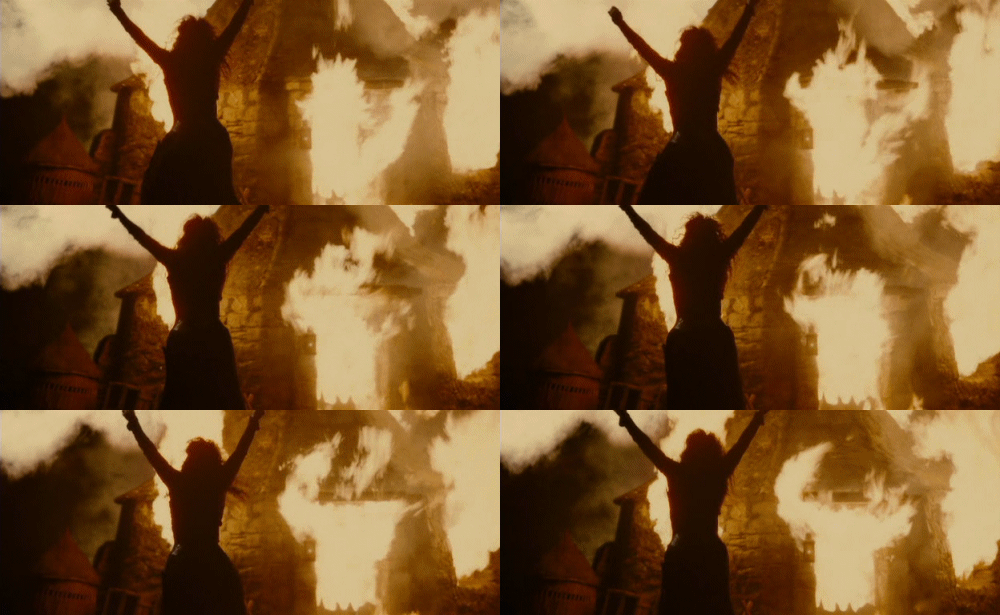
Regan suffers from what you might call and overkill of middle child syndrome. She never had the trust and respect of being the eldest daughter, nor the partiality and babying of being the youngest, and feels herself to be the underdog and as such the most deserving of everything and anything. She was always a bit rotten, and the resentment and frustration that has been building inside her for all the long years of watching her father go senile and she and her husband pushed to the back of all favors, turned inward and inflated her hatred, so that when the opportunity came to prove herself the "best daughter", it came out in passionate violence and revenge upon everyone who she believed had ever wronged her, including her father.

Regan is very impulsive. She gives her emotions free reign over herself and lets them drive her wherever they will. Whatever is happening in that moment, at that second, then all else is forgotten and she does whatever she feels without thinking of the consequences. She does not think ahead, plan or prepare, but instead acts before she thinks and lets herself go down paths without ever bothering to look back and see whether she took a wrong turn. She convinces herself that she doesn't care what anyone else thinks of her, though she has the emotional insecurity of a thirteen year old. Her temper is hot and the farther she gets into her sadistic vengeance the less she is able to control it.

Relationships:
King Lear: Regan hates her father. She believes he is a fool for underestimating her and what she believes she can do, and detests him for preferring Cordelia to her and Goneril. Though she thinks she has wanted his affection and trust all her life, when he comes to her for help and security, any love she once had for him is long gone, and she refuses to be saddled with him, insults him, tries to get her sister to take care of him and finally turns him out of her house, hoping he'll die in the wilderness, and prepares to invade his lands and claim them for herself. She relishes playing him like a puppet before casting him out, because she feels that this is how she has been treated.

Goneril: Though seemingly united in many goals with her sister, such as hatred of Cordelia and annoyance turned aggressiveness with their father, most of the play shows a competition between the two not only for the love of Edmund but also for the lands that were taken from the disowned Cordelia and a constant struggle to one-up the other. As the eldest daughter Goneril was depended upon and trusted more than Regan ever was, and the fact that, as little as their father gave them, Goneril still got more, makes Regan's animosity towards her sister only marginally less than most of the other characters. In the first scene the agree that they must do something about Lear's madness - all future scenes show a fake affection and quarrelsome looks that escalate into an obvious sibling rivalry that prompts Goneril to murder Regan.

Cordelia: Though only in two scenes together, one of which where they are both dead, it is clear that both Goneril and Regan dislike their sister because she is the favorite of their father and always gets the best of everything. While there is little doubt that the good Cordelia deserves this, it does nothing to assuage Regan's feelings of uselessness that she gleaned from the rest of her family. Cordelia's shame and banishment brings glee and vindictive pleasure to Regan, only heightened when her lands are taken and offered to her or Goneril. The war leveled between France and Cornwall/Albany proves that all three sisters have little love and much loathing towards each other that only ends when all of them are dead.

Edmund: The attraction of Edmund for Regan lies in the fact that at their core they have a very similar problem. Regan looks at Edmund and what she sees is not so much the handsome boy of the Duke of Gloucester - rather the fact that he, like her, is the child given little respect, he is the child of whom the father and siblings are ashamed, the child who is never given trust or love. He represents everything that she would like to do to Goneril and Lear, and is seduced by the idea that the bastard can do what she has been trying to do her entire life: rise above the given title of his family to make a name for himself and become the glory of the kingdom. Regan wants to be a part of that regime, the two underdogs getting their rightful place and crushing the undeserving beneath them.

Cornwall: If she ever loved him in the first place, since it was most likely an arranged marriage, Regan's love for her husband stretches only the the point where they both hate Lear, Goneril and Albany and they support each other's cruelty. There is a certain amount of affection between them - they have, after all, been married for many years, and they share a nasty side that comes to fruition in 3.7, but not enough to keep Regan from considering leaving Cornwall for Edmund, as Goneril does with her husband. Cornwall's timely death made it so that she did not have to make that decision, but it is in this scene that we see her softer side for the first and only time. Per her attribute of living in the moment, when Cornwall is wounded by a 'traitorous' servant, she is hesitant to help him but for a moment she forgets Edmund in lieu of a certain tenderness and instinct to care. It is short lived, however, like most of her passions, and when he is safely out of the way she continued to pursue Edmund.

Gloucester: One of the "good guys", Gloucester is rewarded for his loyalty to the king and Cordelia by having his eyes brutally removed by Cornwall at Goneril's suggestion and Regan's egging on. There is little conversation between Regan and the Duke besides insults and vehemence, and Regan sees him much as she sees her own father, thinking he has wronged her saintly Edmund in the same way that Lear has wronged her. He is detestable and dirt beneath her shoe, and is not afraid to inform him so when she gets the opportunity.

Kent: Kent is a supporter of King Lear and therefore must automatically be vermin. Regan begins to show her colder side when Kent is put in the stocks by her husband's will and his sentence prolonged from a few hours to through the day and night by Regan's. Kent is the main male beacon of good in the play alongside Cordelia, and he commits the unforgivable sin of standing up for her wronged sister to the point to treason, which to Regan is everything that must be hated and extinguished.

Oswald: As Goneril's servant, he is a source of information to be used, exploited and pumped dry until he is no longer needed and can then be thrown out with the trash. Regan finds him frustratingly disloyal to everyone except Goneril, who is the one person she needs him to betray, and ergo he constitutes someone very low in her esteem.

Edgar: Though they never speak to each other, Regan references Edgar once or twice, and holds him much as she holds Goneril: a usurper of the rightful and deserving ruler. Regan is the one who mentions that Edgar is Lear's godson, and this most likely does little to make her like him more; he is just another person Lear prefers to his own daughter.

Albany: They rarely speak to each other, but when they do it is for Albany to rightly condemn and Regan to stand in horror as the poison Goneril has given her spreads. To Regan, Albany is a lesser version of her sister - less calculating, much less evil, but still greedy for the lands that Regan and Cornwall wants and the other half of the opposition that she hates. He is, however, a reason why Edmund should not have Goneril, and therefore useful to a certain extent, and he is formal to her, allowing her to be escorted away from the judgment the rest face imminently when she becomes sick, and shows respect for his dead sister in law by having her face covered even in light of her wretchedness.

Fool: Though only onstage together once and never speaking to each other, one can only assume that, judging by Regan's character and Fool's behavior, that Regan sees him as a spouter of nonsense and lies that he father listens to more than he does her and a personal insult to the royal house and herself.

Regan is one of 9 dead characters at the end of the play, one of 5 who were murdered and not dead by suicide or heart failure, and one of 5 killed offstage. Thus she ends, without the Shakespearean habit of giving a dramatic speech.

Regan is the second daughter to King Lear and the wife of the Duke of Cornwall. Different from King Lear, who starts insane and gets slowly more in control of his mind as the play progresses, and Edgar, who only pretends to be mad, Regan is the only character who seems stable enough at the beginning while she appears to be gradually getting more and more twisted and bordering insanity as her passions and volitions take control of her.
Regan suffers from what you might call and overkill of middle child syndrome. She never had the trust and respect of being the eldest daughter, nor the partiality and babying of being the youngest, and feels herself to be the underdog and as such the most deserving of everything and anything. She was always a bit rotten, and the resentment and frustration that has been building inside her for all the long years of watching her father go senile and she and her husband pushed to the back of all favors, turned inward and inflated her hatred, so that when the opportunity came to prove herself the "best daughter", it came out in passionate violence and revenge upon everyone who she believed had ever wronged her, including her father.
Regan is very impulsive. She gives her emotions free reign over herself and lets them drive her wherever they will. Whatever is happening in that moment, at that second, then all else is forgotten and she does whatever she feels without thinking of the consequences. She does not think ahead, plan or prepare, but instead acts before she thinks and lets herself go down paths without ever bothering to look back and see whether she took a wrong turn. She convinces herself that she doesn't care what anyone else thinks of her, though she has the emotional insecurity of a thirteen year old. Her temper is hot and the farther she gets into her sadistic vengeance the less she is able to control it.
Relationships:
King Lear: Regan hates her father. She believes he is a fool for underestimating her and what she believes she can do, and detests him for preferring Cordelia to her and Goneril. Though she thinks she has wanted his affection and trust all her life, when he comes to her for help and security, any love she once had for him is long gone, and she refuses to be saddled with him, insults him, tries to get her sister to take care of him and finally turns him out of her house, hoping he'll die in the wilderness, and prepares to invade his lands and claim them for herself. She relishes playing him like a puppet before casting him out, because she feels that this is how she has been treated.
Goneril: Though seemingly united in many goals with her sister, such as hatred of Cordelia and annoyance turned aggressiveness with their father, most of the play shows a competition between the two not only for the love of Edmund but also for the lands that were taken from the disowned Cordelia and a constant struggle to one-up the other. As the eldest daughter Goneril was depended upon and trusted more than Regan ever was, and the fact that, as little as their father gave them, Goneril still got more, makes Regan's animosity towards her sister only marginally less than most of the other characters. In the first scene the agree that they must do something about Lear's madness - all future scenes show a fake affection and quarrelsome looks that escalate into an obvious sibling rivalry that prompts Goneril to murder Regan.
Cordelia: Though only in two scenes together, one of which where they are both dead, it is clear that both Goneril and Regan dislike their sister because she is the favorite of their father and always gets the best of everything. While there is little doubt that the good Cordelia deserves this, it does nothing to assuage Regan's feelings of uselessness that she gleaned from the rest of her family. Cordelia's shame and banishment brings glee and vindictive pleasure to Regan, only heightened when her lands are taken and offered to her or Goneril. The war leveled between France and Cornwall/Albany proves that all three sisters have little love and much loathing towards each other that only ends when all of them are dead.
Edmund: The attraction of Edmund for Regan lies in the fact that at their core they have a very similar problem. Regan looks at Edmund and what she sees is not so much the handsome boy of the Duke of Gloucester - rather the fact that he, like her, is the child given little respect, he is the child of whom the father and siblings are ashamed, the child who is never given trust or love. He represents everything that she would like to do to Goneril and Lear, and is seduced by the idea that the bastard can do what she has been trying to do her entire life: rise above the given title of his family to make a name for himself and become the glory of the kingdom. Regan wants to be a part of that regime, the two underdogs getting their rightful place and crushing the undeserving beneath them.
Cornwall: If she ever loved him in the first place, since it was most likely an arranged marriage, Regan's love for her husband stretches only the the point where they both hate Lear, Goneril and Albany and they support each other's cruelty. There is a certain amount of affection between them - they have, after all, been married for many years, and they share a nasty side that comes to fruition in 3.7, but not enough to keep Regan from considering leaving Cornwall for Edmund, as Goneril does with her husband. Cornwall's timely death made it so that she did not have to make that decision, but it is in this scene that we see her softer side for the first and only time. Per her attribute of living in the moment, when Cornwall is wounded by a 'traitorous' servant, she is hesitant to help him but for a moment she forgets Edmund in lieu of a certain tenderness and instinct to care. It is short lived, however, like most of her passions, and when he is safely out of the way she continued to pursue Edmund.
Gloucester: One of the "good guys", Gloucester is rewarded for his loyalty to the king and Cordelia by having his eyes brutally removed by Cornwall at Goneril's suggestion and Regan's egging on. There is little conversation between Regan and the Duke besides insults and vehemence, and Regan sees him much as she sees her own father, thinking he has wronged her saintly Edmund in the same way that Lear has wronged her. He is detestable and dirt beneath her shoe, and is not afraid to inform him so when she gets the opportunity.
Kent: Kent is a supporter of King Lear and therefore must automatically be vermin. Regan begins to show her colder side when Kent is put in the stocks by her husband's will and his sentence prolonged from a few hours to through the day and night by Regan's. Kent is the main male beacon of good in the play alongside Cordelia, and he commits the unforgivable sin of standing up for her wronged sister to the point to treason, which to Regan is everything that must be hated and extinguished.
Oswald: As Goneril's servant, he is a source of information to be used, exploited and pumped dry until he is no longer needed and can then be thrown out with the trash. Regan finds him frustratingly disloyal to everyone except Goneril, who is the one person she needs him to betray, and ergo he constitutes someone very low in her esteem.
Edgar: Though they never speak to each other, Regan references Edgar once or twice, and holds him much as she holds Goneril: a usurper of the rightful and deserving ruler. Regan is the one who mentions that Edgar is Lear's godson, and this most likely does little to make her like him more; he is just another person Lear prefers to his own daughter.
Albany: They rarely speak to each other, but when they do it is for Albany to rightly condemn and Regan to stand in horror as the poison Goneril has given her spreads. To Regan, Albany is a lesser version of her sister - less calculating, much less evil, but still greedy for the lands that Regan and Cornwall wants and the other half of the opposition that she hates. He is, however, a reason why Edmund should not have Goneril, and therefore useful to a certain extent, and he is formal to her, allowing her to be escorted away from the judgment the rest face imminently when she becomes sick, and shows respect for his dead sister in law by having her face covered even in light of her wretchedness.
Fool: Though only onstage together once and never speaking to each other, one can only assume that, judging by Regan's character and Fool's behavior, that Regan sees him as a spouter of nonsense and lies that he father listens to more than he does her and a personal insult to the royal house and herself.
Regan is one of 9 dead characters at the end of the play, one of 5 who were murdered and not dead by suicide or heart failure, and one of 5 killed offstage. Thus she ends, without the Shakespearean habit of giving a dramatic speech.
Saturday, September 27, 2014
On Why I Still Love M Night Shyamalan (and a special spot for Joaquin Phoenix).
THE FOLLOWING POST CONTAINS SPOILERS
Ok, I will come clean right now; this is a complete nerd post. I am a film freak and a passionate actress, and likely you will find that it comes out very clearly in my scribbles. Feel free to judge, just not too harshly.
Though I can't pinpoint the exact moment, I have wanted to be an actress from, lets say, around six or seven. Previous to this wish I was destined to be a fireman, but my older brother informed me that to do so I had to enter burning buildings. Suddenly, it wasn't all sliding down poles in your pajamas.
I had to change my sights, and set out to discover a new horizon. I won't bore you with the nitty gritty details.
I'll just skip right to the now sixteen year old me, struggling just to keep straight A's in my high school, going into senior year at a 365 days disadvantage to the rest of my class, with my friends going of the college and my staying home for a gap year looming on the horizon. For about a decade now it had been my firm dream and belief that films were meant for me. I've prayed about it, tried to let it go, gone the nine yards in discernment. I could still be wrong, and need some more time, but I will wait for God to open or close a door and in the meantime pursue my dream.
Anyway, that's not why I'm here. Maybe someday when I'm famous I'll write a book about my journey, but not today. Today I focus on the day that brought it all back into a stunning reality for me. Nine or ten years of dreaming doesn't get you real far when you don't do anything about it, and I have to be honest, as much as I wanted to act I had let the passion run stale. I was no longer confident in going forward with my decisions, and had basically let it all fade to a back - burner.
I am going to make something very clear, and this is significant: At the beginning of my dream career, as I planned my life, I swore that I would never act in a horror movie. I find the gore-fests and sex-glorifying 'horror' films of today that feed on everyone dying gruesomely and jump scares to pretty much be the tip of the trash heap in film. I myself get frightened very easily, so not only was I not to act in them, I decided against watching even classic horror like Psycho and Poltergeist. It just freaks me out. For a long time this kept me away from what would become my jumper cables back into my passion.
One night while hanging out in the basement my older brother hurt my feelings and, to make up for it, offered to watch The Village with me the next day. As his favorite of Shyamalan's films, and the fact that I was usually the one to drag him into watching something with me, I accepted; probably also because I realized that I couldn't call myself a movie lover without having seen The Sixth Sense, and I wanted to ease myself into that horror story with a slightly less frightening film of this director named Emnite Shy-something.
So there I was, the next day, wrapped up in a huge blanket and nibbling on pretzels, ready to dive under the table or scream into my blanket if necessary. Oh, I had heard horrors about the Village. Scary, I heard. Terrifying, I heard. Filled with suspense, I heard.
It sucks, I heard.
I grit my teeth and prepared myself.
I watched, and I never let my eyes drift away from the screen. I was riveted; but not because I was scared.
I have a section to discuss The Village later. For right now I'll skip the movie and tell you what happened next. I went out and rented Signs and watched it, and after that popped in the Sixth Sense. M Night - and Joaquin Phoenix, who I shall also give a few paragraphs to - had kick-started my passion again. I wanted to fly. I wanted to buy a ticket to California, walk into Hollywood and announce that hello, I was going to be working here for a few decades and could you tell me where Mr. Shyamalan was? I'd like to give him a really big hug. And call Mr. Phoenix in too, if you don't mind, because I need to inform him that he just changed my life.
I am going to give you a bit on M Night before I give you my take on what I find to be his five greatest successes (in order of release): The Sixth Sense, Unbreakable, Signs, The Village, and Lady in the Water. M Night was 22 when he made his directorial debut with a film that, frankly, nobody saw: Praying with Anger. He was 28 when he made his next film, Wide Awake, that got more notice because of names like Rosie O'Donnell and Dennis Leary, but most people either didn't know it was him or didn't even know it existed.
These two original movies of his were understandably swept over when, only two years later, the thirty year old M Night created his most famous masterpiece, The Sixth Sense, which got not only a lot of attention from fans and critics alike but also skyrocketed M Night to the pinnacle of movie making and earned 6 Oscar nominations to boot, including Best Picture.
Suddenly, Mr. Shyamalan wasn't some no name from India. He was famous, he was admired, he was hailed as the next Steven Spielberg. Unfortunately, this film also proved to be what a lot of people consider to be the paving of the way for his downfall. More on that later.
So why do I love this guy so much? Yeah, he made some good movies. So what?
I'll admit it, I came late to the game. Later than I ever would have come if I had known what he could do. So I missed all the hype when his latest movies came out. By the time I had bothered to see his movies, the most I knew about him was that most people's opinion came down to something along the lines of: "I can't believe the guy who did Sixth Sense directed THIS (use The Happening, Avatar, Lady in the Water or After Earth interchangeably).
But me? All I knew was that I had seen something I had never seen before. I think, for me, that's what his films really came down to. I had seen something in The Village, and in the subsequent films I watched, that I had never seen in any other movie. I can't even put my finger on it; it was a blend of well cast, well scripted, and I think above all the underlying themes and beautiful artistry that wove it all together.
It was, to put bluntly, a breath of fresh air. I look at the box office today, and I see four types of films; oober romantic, whether disgusting comedy like Sex Tape or dramatic coming of age cliche like The Fault in Our Stars; Bloody horror like I described above; Superhero/ Action movies where people I know have fallen asleep to things constantly blowing up and woken up forty five minutes later to things STILL blowing up; and War and Slavery films trying to raise awareness of things in the past without really giving us a lot of solid historical fact at all. Not that all of these movies are bad: some of them are good, and obviously there are many exceptions to these four mainstream genres.
But I don't think I have seen a truly great movie in theaters in a while.
M Night changed everything. He was different, and I think these are the three biggest reasons why (note: these pertain to the five films I mentioned earlier, not his later ones):
#1 Taking the time to think.
Wait, you mean we went an entire movie without something blowing up? Two movies? Three movies? Gosh, how did we survive? There is a stimulating mentality that has gotten into our films these days with viciously high definition pictures to the point where everything looks fake and hurts your eyes, extreme closeups where you can count every pore on someone's face, something blowing up every few seconds, and worst of all the constant need for scenes to cut to the next one lickety - split, one liner dialogues and an inability to have two characters share a realistic conversation because people will supposedly get bored by how slowly it is moving.
One of M Night's signature aspects in his films is the fact that he takes a longer time with scenes; conversations are often held at a distance away where you cannot clearly see the subject's face, dialogue is drawn out so that the characters have a chance to show that yes, they can actually speak to each other normally, and finally his camera angles and shots that are artistic and creative, contemplative and leaving you a moment to take in the previous scene and realize what you actually witnessed.
#2 Not Horror
Probably the most common misconception of M Night's films is that people think they are horror. One of the reasons many people disliked The Village and even more so some of his other films were complaints about them "not being scary enough". Let's get something on the table right now: Shyamalan's films are very clearly rated as thrillers. To be exact, psychological thrillers. Yes, the trailers can easily give the horror illusion, and yes, The Sixth Sense has some pretty big jump scenes and the entire concept was pretty horrifying. But I watched these movies, and I barely saw the jump scares.
I saw that the true horror lay, not in the claws of Those We Do Not Speak Of, not in the bloody hole in the back of the teenager's head or the alien onscreen, but rather in the undertones of the film. Not what you saw, but what you didn't see. What was only implied, or the realistic, fearful situation. In his films I didn't just watch ghosts scare a kid or a town living in constant fear from monsters. I wasn't turned off by constant violent deaths, possessed people whose families are too stupid to get a priest to help or a festival of cheap porn. It was, in short, the thrill of watching people experience life changing events based on past failures and weaknesses. I watched the consequences of actions unfold into a believable, fearful way of life. The mind horror behind the movies just exploded onscreen more than any burning building Superman could throw at General Zod.
I lay awake at night after watching these movies, not because I feared something would grab me out of the dark, but rather because I was thinking, constantly thinking about the movies...they are psychological thriller masterpieces.
#3 Artistic Threads and Patience
Lets just face it, his films are filled with creativity and artistry that the rest of we mere mortals can only dream of. How many people actually figured out the significance of red in the Sixth Sense without someone telling us, or that M Night strictly forbid that color in any scene that wasn't a cross-over between the spirit world and ours? The original name of The Village was Grey; was this Lucius' never-told color, the balance between the innocent goodness of yellow and the bloody, harsh truth of red? Did you know that Bruce Willis is left-handed and he taught himself the write right-handed in the Sixth Sense because M Night didn't want anyone to notice that he didn't have his wedding ring? You can tell, I am told, because he circles things in a clock-wise fashion, the way left-handed people do. I mean, who even thinks of those things?
More importantly, do they matter that much?
No. And that's the beauty. They're in the films, you can see them if you want, but they aren't crucial. They're just added bits of pleasure and fun that he patiently took the time to work with his cast and crew members so that we, the audience, could enjoy some radical films, without disturbing the main plot line of the movie. They are the difference between a good film and a great film. He is a brilliant man, M Night. And it shows.
I could mention many more elements of his films: They tend to be on a small scale, personal level (in Signs they alien invasion was not shot from a worldwide view, but rather focused on a single farm and a single family). He usually writes, directs and produces his films. There are often religious elements in his films, and religious symbolism. He tends to reuse actors/actresses in his movies, and also cameos Alfred Hitchcock style in many of his films.
Surprised I didn't mention twists in the big three?
As I stated earlier, I think that while many hail Sixth Sense as his greatest achievement, it was also very difficult for him to live up to everyone's expectations after that. Everyone expected a massive twist that no one would see coming at the end of all of his movies. People raged at Signs and The Village because they were 'predictable twists'. No offense to anyone, but just because he did it once doesn't mean he has to do it every time. There are small twists, sure, but like people complained, predictable. Some films, like Lady in the Water, didn't really have twists at all. Its unfair to base all of his films on one (albeit a great one). When people starting getting expectant, they became dissatisfied. I'm sure we've all had the frustrating experience of having a movie hyped up for us or being excited by a trailer and have our expectations put at unrealistic levels, and coming out of the theater disappointed. In M Night's case, we have no one to blame but ourselves. Perhaps many his films after Sixth Sense aren't as high caliber, but it doesn't make them bad films. In fact for many I think Signs and Unbreakable are first choice. I know a few people, myself included, whose favorite is The Village. While I've yet to meet someone whose top pick is Lady in the Water, it does not mean that it was a terrible movie. Actually, it was a wonderful movie.
I will now review my personal opinion of the films, not in order of their release but rather in the order that I viewed them. Its easier for me to keep track that way.
The Village, 2004, Starring Joaquin Phoenix and Bryce Dallas Howard


WHY IT IS GOOD: Perfectly cast, with maybe the exception of Judy Greer, whose voice doesn't quite sound right with the rest of the cast, The Village is exciting but also so full of the artistic beauty that of all his films, this is the one, set in the innocence of nature, that gives time in the film itself for contemplation. Joaquin Phoenix pulls off a spotless performance as Lucius Hunt, the shy and withdrawn boy of the village on the outskirts of Covington Woods. Bryce Dallas Howard, who most people recognize from Lady in the Water and her later roll as Hilly Holbrook in The Help, does an incredible job. I was blown away in scene after scene that she was in, specifically with her ability to portray fear and grief without going overboard and hyperventilating like I see too many actresses do these days. I'm surprised she hasn't won an Oscar for something yet. The supporting cast of William Hurt, Adrian Brody and Sigourney Weaver pull it all together for a film that draws you into the lives of these characters.
Not a day goes by that I don't think of this movie. The entire film has a bleak undertone and while there are suspenseful moments, I think most people got bored when they found out that there were no monsters. Not me. For me, the monsters were very real indeed. The monsters were the people who had brutally killed the Elders' loved ones, and they were the lives of pain that they had locked up inside themselves. The monsters were even more so the Elders themselves, ruling their children by a terrible, constant fear in an effort to keep them from pain that they simply cannot escape, because as Mr. Walker points out, "Heartache is a part of life. We know that now." Nevertheless, their final decision at the end of the movie to continue the illusion of frightening beasts to hide the real illusion of the modern-day town represents the fact that they let themselves be controlled by a constant fear and place the same burden on their children, which is monstrous. Still, you feel a wretched pity for these most likely psychologically unbalanced people who had everything they loved ripped from them and therefore did cruel things to their offspring in the hopes that they were being kind and preserving the innocence. You cannot say that their heart wasn't in the right place.
It is too easy to acquit or condemn their choices, but I don't think it is meant to be black and white. Real life rarely is, after all, and the whole movie is very grey-tinged, because the choices all fall into the grey area of morality. It is not a depressing movie, but one certainly cannot classify it as cheerful or even happy. As I said before, it a stark, bleak film shot with very little bright color and where the fear that the people live in is tangible. Some people I know complained that they couldn't 'relate' to the characters so it wasn't as scary. I didn't have to relate. I could taste their terror just from something as simple as a camera angle and the lighting. I felt every emotion that crossed Ivy Walker's face; looking back on some of Lucius' lines still gives me butterflies, remembering how I could feel what he did in the pit of my stomach as he said it.
Topped off with a hauntingly beautiful soundtrack that nabbed an Oscar nomination and holds a very honored place on my Spotify list, a clever cameo by the director himself and just enough jump scares to keep you hopping, The Village is one of M Night's best masterpieces.
WHY PEOPLE DON'T LIKE IT: The Village was the film that set most people against M Night with what they called a "predictable ending". I suppose it was predictable: I had no idea when I saw it, but the three friends I later watched it with all figured it out. It's likely that I'm just stupid that way, but to be honest I wasn't trying to figure it out. To be fair, I wasn't expecting a twist in the least like many others, so I wasn't looking for one. But I discussed the unfair assumptions in a previous section. The truth is that The Village simply has a different feel to it than the Sixth Sense, and it is much more of a psychological thriller than any of the others, and people didn't expect that.
Other complaints:
It "wasn't scary enough" So-and-so walked into it expecting to be scared and thought there weren't enough frightening scenes. Like I said, this guy isn't a horror movie director. There were scenes worthy of this title in Sixth Sense, surely, and that trained people's brains to assume. But even that film isn't classified in the horror genre, and much less so is The Village. The audience's erroneous conclusions are no one's fault but their own, and their frustration is taken out on the film itself. TO BE FAIR the trailer made it look like a movie where everyone would be viciously slaughtered by huge evil monsters. This was bad marketing, but it doesn't necessarily detract from the movie itself.
Why send Ivy? Why doesn't one of the elders go? It's so stupid that they'd send the blind girl alone into the woods to get medicine! They've got to be insane or something. Remember that the Elders swore an oath that they would never go back to the towns. These people took oaths very, very seriously. Obviously if they weren't serious about it they wouldn't have packed up and gone in the first place. As for them being insane, I actually think that most of them probably are a little bit mentally deranged because of what happened to them. They met at a counseling center, remember. I'm not saying it would happen to everyone if someone they loved died - it doesn't happen to most people - but M Night chose to make a film about these specific dozen Elders who went a bit crazy with grief and wanted to go create a Utopian society of innocence.
And why send Ivy? In the selfish and pained minds of the Elders, Ivy alone could go and get the medicine because, remember, the real illusion they tried to create was not so much that there were monsters but rather that there was no modern world. Ivy, who was blind, would not grasp this reality in the same way that a person who could see would. For them, Ivy could get medicine without bringing an end to the innocence of their village.
As for going alone, they didn't send her alone. They sent two boys with her that she would leave once she got to the road to town so she could go alone to get medicine and then return with them, remember? It was a complication that they hadn't foreseen, however, that the fear they had created ran so deep that the boys ran in terror. Ran in terror as Ivy would have done had she not been driven by love for Lucius. Isn't that what all the decisions in this movie are driven by? Love, loss of love, love rejection and fear of losing love. The Village is, as I heard someone put it, first a foremost a love story.
Ivy, as Mr Walker says, is 'more capable' than many people in the Village. While he doesn't expound it is clear that Ivy isn't helpless. Her lack of sight would be guided by the two escorts, and her strength would take her down the road to get medicine.
Signs, 2002, starring Mel Gibson and Joaquin Phoenix


WHY IT IS GOOD: This is a fan favorite over The Village and sometimes even Unbreakable. Also very well cast; though Rory Culkin wasn't on top of his game the whole time, Abigail Breslin could have nabbed a Golden Globe nomination or something for her performance as Bo Hess. Mel Gibson did well though I think he was outshone by Joaquin Phoenix in this film. It definitely had more humor than Shyamalan's other films, and had a more definite plot line and means to get to an end. Also, it focused on the element of family and recovering a lost faith after the death of a loved one, an experience so many people have gone through. It also brought everyone's favorite subject - aliens - into a frightening realistic situation of an attack in your own home and worst-case scenario like being trapped in a basement with an asthma attack and no way to get your medicine. It explored faith and emotion and fear, and most people say it is far scarier than The Village. There is subtlety; one of my favorite scenes is in the basement when Morgan is having his asthma attack and as Merrill and Bo watch helplessly, the camera zooms ever so slightly onto Merrill's face in particular. It stays there and while he tears up he is moving his lips just barely enough and long enough that you can tell he is praying. It is so small a thing, but it just adds to the richness. Signs is the kind of movie that you can watch a lot and not get tired of, and also never understand everything. I have heard many different theories, such as that the aliens were there to help, the alien that almost killed Morgan was really Colleen or that it was all a dream, and there is enough sufficient evidence to support them that you can view it over and over, and never the same way twice.
WHY PEOPLE DON'T LIKE IT: Despite it good merits, people had problems, again, with the lack of fear in this film. It is much more surface-level (i.e. jump scares) than the way The Village simply reeks of a hidden oppression, and while Shyamalan does a good job of not clearly seeing the aliens, I think people would have preferred a bit more attack and less invasion. Small wonder everyone's favorite scene is Merrill beating the crap out of an alien with a baseball bat - for most people, it was about time! The script is also more disjointed than his other movies, such as Graham giving a nice speech to comfort Merrill, who then asks what Graham believes, and Graham, responds with a conversation-closing "Are you comforted?" When Merrill responds positively he says "Then why does it matter?". It would have been a good place to end, except that Graham decided he would crush Merrill's comfort and faith by telling him his wife's last words. Bit of a downer, eh? We were all glad when Merrill stood up to his brother in the basement.
Other main complaints include:
Why did he have to bring his faith into it? It would have been a better movie without it. Listen, I don't care if you're atheist or whatever, and I'm pretty sure M Night doesn't either. Anyone who is serious about their faith can find a spot for it in their film, and it was beautifully done. Sorry if you don't have a faith, but that's not his problem.
It's so dumb that the water defeated the aliens! Wouldn't they check that the planet they were attacking was mostly made up of water? What a stupid plot twist! First of all, let's remind you all that it is not a plot twist; M Night's character mentions it halfway through the film that they don't like water, and that the reason they made the crop circle maps are because they wanted to be away from the lakes and oceans, in a dry spot. Obviously they knew the planet was mostly water, that's why they made their landmarks where they did. What the aliens didn't know was the the we knew they didn't like it, and no one should have been surprised when Bo's neglected glasses killed off the last invader. If that "twist" shocked you, you obviously weren't paying attention.
Myself, I found Signs much less frightening then The Village. Aliens are not as realistic and overall I didn't find the jump scares as compelling. I also found many things very predictable, from what line would come next in a character's sentence to Merrill having an epic scene with a baseball bat to an alien appearing in the living room (seriously, when someone says "I'm going to get the TV" no camera follows the guy out of the room, into the closet, down the hall with the TV and back out unless there's going to be something that wasn't there when he left). I also always wondered why Merrill missed the large extraterrestrial when he scanned the house before bringing the rest of the family up, but these are minor problems that are easily overlooked and don 't detract too much from the film.
Before I start on Sixth Sense, I'm going to dedicate a section of this to Joaquin Phoenix. As I said before, M Night wasn't the only one who encouraged me to look more seriously into acting.
Previously I had only seen Mr. Phoenix in Gladiator and, though I didn't realize it, Brother Bear. In Gladiator I was impressed by his ability but disgusted by his character and was focused on analyzing Russell Crowe's performance above all else. When I sat down to watch the Village, I was pleased because "that guy who was really good in Gladiator would be in it". What I hadn't bargained for was being phenomenally in awe of his portrayal of Lucius Hunt. The character was beautiful and every time one of the girls in the movie proclaimed their love for him I concurred wholeheartedly.
When I watched Signs I was thrilled to see him play an every bit as attractive character but with a completely opposite temperament to the silent Lucius. He was realistic and believable and seeing him in these films caused me to do some more research on this guy who previously I had only known as the bad guy in my brother's favorite movie.
While I discovered that he was a vegan and an atheist, two things I will simply never understand, I also found out that he was pretty much everything I had always respected about Hollywood actors. He was never typecast and played a vast variety of roles, something I had always wanted to do. Even from the three movies I had seen him in, I was aware that this man could pretty much do anything. I liked that he wasn't conventionally handsome; he didn't have a perfect body, and even less so a perfect face, so while the rest of my friends ogled at Chris Pine, I pondered how cool it was that the dark circles under his eyes and his scar didn't detract from a performance, but rather enhanced the facial expressions and, quite frankly, made it all the more attractive to me. I remember telling one friend what an incredible actor he was, and she said bluntly "That guy? I think he's ugly." I tried very hard not to laugh in her face and instead calmly recommended that she watch something with him in it before she made a call like that. Just about the most good I ever managed to get from a friend about him was "he was great comic relief in Signs" and "I like his hair in The Village."
But more importantly, I saw that he took every film seriously. When he wanted to do a character, he didn't just put on the costume and do what the director told him to do. He went the whole nine yards and changed himself, putting everything into his roles: Changing his voice tone for Walk the Line instead of simply moving the songs up a few notes, as they had been planning to do, putting on weight and getting white for Gladiator (something I in particular can appreciate, being an Irish marshmallow surrounded by people getting tans; people telling me "hey, to be white was the height of fashion 2000 years ago" isn't exactly comforting). I heard that he ad libbed his scream of "Am I not merciful?!", which I think is the only time in the whole movie he really raises his voice, and got so emotionally involved in the scene where he kills Marcus Aurelius that he fainted afterwards. That is dedication, right there. His talent and resolve is everything I have always wanted to be in an actor. There are only a couple of other actors with that kind of resignation to ruining physical attributes: people like Tom Hanks, Brad Pitt, most notably Christian Bale who is likely to suffer from The Machinist all his life.
Of course my family laughs at me and thinks I'm insane, assuming I'm just going through another of my phases. They say things like "You can't be in love with 40 year -old men that you don't even know!" (although I think he's only 39). What I've pretty much given up explaining to them is the fact that I'm not in love with Joaquin Phoenix. I am in love with the idea of his talent, and I am admittedly attracted to his characters of Lucius and Merrill. But it is because of what he brings to them rather than he himself. As I told my sister, who is in college, "Sarah, you're majoring in Math, because its what you want to do, right? I watch movies, I find out everything I can about people like Joaquin Phoenix because this is something I want to spend the rest of my life doing. What he does, that's what I want to be able to portray. That's what I want to be able to give people." I'm not sure if I got the point across, but it quieted her down for a few hours, until I happened to mention his name again. They say he's done bad movies; I'm not the kind of person who, if I like an actor, wants to watch every movie they've ever done. I know he's done films I don't agree with; there are precious few actors who haven't. But it doesn't mean I don't idolize what I do like that he's done, and it doesn't mean I'm going to despise him. After all, look what he's given me!
Wrapping up, I re-watched Gladiator and saw that, once again Mr. Phoenix had created something incredible to match Russell Crowe's fantastic Maximus. I found myself almost crying with a sort of sickened pity for Commodus, because Joaquin brought that to the forefront and forced me to see it even when I just wanted to condemn him. No one likes a villain who is just vile and has no motive. Its why we are drawn to Loki, Bane, The Joker; people who have lived pathetic lives by no fault of their own and came out hating the world and fearing it as well. Yes, Commodus is twisted, sadistic, wrong on a number of levels and violent and cruel. But instead of automatically damning him, I watched for motives, and I found all too many of them. I'd go father but this isn't a character study of the emperor so I will close with this: Joaquin Phoenix skyrocketed to number two on my list of favorite actors. Everything he did in these films strengthened my resolve to, God willing, make it in Hollywood. I love to become characters, all kinds of characters, to explore them and make them a part of myself, and his performances reminded me of this love. If I ever meet him, as I hope and pray I will, I want to thank him for what he has given me.
The Sixth Sense, 1999, starring Bruce Willis and Haley Joel Osment.


WHY IT IS GOOD: It is universally acknowledged that the Sixth Sense is M Night's greatest achievement. You'd think no one had ever heard of a twist ending, the way they rave about this film. Indeed, the surprise plot twist has pretty much become a cultural reference; or it would have, if anyone spoke of it. If God had issued an eleventh commandment, I think this would be it:
XI: THOUGH SHALT NOT TELL THY NEIGHBOR THE END OF THE SIXTH SENSE
I myself had the ending spoiled for me (don't watch ScreenJunkies "Worst M Night Shyamalan movie because they gave it away. I almost sued them I was so mad), but it didn't mean that it wasn't a fantastic watch. Wonderfully cast, especially in the case of young Haley Joel Osment (where did he FIND this kid? he is AMAZING), who grabbed an Oscar nomination for his portrayal of the frightened young boy who can see dead people, The Sixth Sense is a story that could easily mislead people into thinking M Night's specialty is horror. Gruesome and frightening ghosts fill its scenes, but there is constantly a deeper message of communication and love. One of the actresses claims that she was so moved by the emotion in the film she didn't even realize it was supposed to be a horror movie (which, as we know, it wasn't).
Besides being masterfully filmed and well scripted, The Sixth Sense really showcases M Night's patience and artistic genius: the use of the color red in nail polish, ink, doorknobs, clothes and other ordinary everyday articles painstakingly used in all the scenes that show a crossover between the spirit world and ours and forcefully omitted in all others. It was also filmed in sequence, rare in many films. As I mentioned before, Bruce Willis learned to write right handed so that sharp-eyed viewers would not notice his lack of a wedding ring. The film's famous line "I see dead people" has gone down in history alongside "Say hello to my little friend" and "Here's looking at you, kid".
WHY PEOPLE DON'T LIKE IT: There are only a couple of really nit-picky people who can claim that they didn't like the Sixth Sense, my mother included. Some people just didn't like the fear, which is understandable. As far as bad technicality goes, the main complaints seem to be:
Wouldn't Malcolm notice that his wife literally never talks to him? People's marriages don't fall apart in a matter of days to the point where they never speak. Doesn't he notice that NOBODY ever sees him or speaks to him? How did he get his information on Cole if no one could give it to him or buy anything from a store? Its ridiculous! Basically, the answer to this question is the fact that everything we see, we see from Malcolm's point of view. He doesn't realize that he is dead, and lives in a sort of dream world where he has no reason to assume he is invisible to everyone else, and often perceives things in a way that they aren't (like the table in front of the basement door; he is still able to get into his study without a key but obviously can't physically get in so he must appear there and not realize that he just appeared without going through the door). In dreams, we often go from place to place and don't realize that we never actually got there by walking or driving or any other method of transportation. Everything Malcolm sees, like his information on Cole and buying a new coat or something, he sees because its what he needs to see, wants to see and expects to see. Time doesn't go the same way for Malcolm as it does for us; and often he believes his wife does talk to him, as cleverly shown in the restaurant scene.
Wouldn't Cole notice that Malcolm was dead if he can see dead people? Wouldn't he see the bloody bullets wound like he does on everyone else? The answer is that Cole DOES realize Malcolm is dead. It is why he runs from him and hides in a church when he first sees him, and it is probably why he never mentions "that psychiatrist you're making me see" to his mother, since he knows his mother can't see him. Remember, the reason we never see the bloody wound is because we are seeing Malcolm as he sees himself, and that is alive and well. Cole, however, I'm sure realizes that Malcolm is very much dead, but doesn't want to tell Malcolm, perhaps because Malcolm is unlike many of the other ghosts and instead of harming him is helping him. This is why he seems confident when he tells Malcolm he won't see him again tomorrow, because he knows that once a ghost's purpose is fulfilled then it disappears. He realizes that Malcolm's problem was guilt over Vincent, and once he has redeemed himself by helping Cole, the game will be up and Malcolm won't be coming to see him anymore.
Unbreakable, 2000, starring Bruce Willis and Samuel L Jackson


WHY IT IS GOOD: Unbreakable is M Night's personal favorite that he has done, and I think many people would agree. It is a gritty story of comic book heroism in the real world, a tale of something we all wish existed - superheroes - told in a realistic fashion that doesn't involve demigods, aliens or Iron Man; instead it is a man with a rare gift struggling to understand it, and the pitiable Mr. Glass helping him to find his place in the world. Critically acclaimed as one of Samuel L Jackson's best performances, Unbreakable is well acted and well-paced; not scary like many of his other films, but suspenseful, dramatic, marketed to superhero lovers and drama people alike, and most of all, sad. Not in the tone of The Village, that simply has that undertone that seeps into your skin, but very forcefully shoved in your face, specifically in the last minute and a half. Many people like that it took superheroes "seriously".
This was also a rich display of the hidden perks M Night likes to put in for observant audiences; when David meets Elijah and is told about his theory, they are wearing red and purple shirts (respectively), representing opposite ends of the color spectrum. Many of Mr. Glass's scenes involve glass - his walking stick, TV screens, mirrors, etc. Bruce Willis' David Dunn is an alliteration, like Bruce Banner, Peter Parker, Clark Kent, and so on. Elijah's first comic book is said to have a "surprise ending", just like the film. These are only a few of the subtle touches Shyamalan puts into this film.
For me, Unbreakable had an oddly different feel from his other films. It is without the whimsical bleakness of The Village, the fright and horror of The Sixth Sense, the fairy-tale land of Lady in the Water and the unrealism of aliens in Signs. Combining one of history's favorite past times of comic books heroes with the very real world of crime made for an intriguing film that made me understand why my friends said, when they heard I had seen The Village "Ok, you gotta watch Unbreakable next!"
WHY PEOPLE DON'T LIKE IT: You've got your person who doesn't appreciate a movie that's not choc-full of explosions and bloody bodies and fist fights. There is enough action in this film to tide your average audience over, but it was definitely more of a drama and emotional look into the lives of two unbreakable and at the same time broken men, one mentally unbeatable but physically frail, and vice versa. I accept people who just don't like the genres this film fits into, but anyone who tried to argue against technicality and execution just aren't thinking about it hard enough.
The main complaints are:
It was so boring! I thought this was supposed to be a superhero movie. Way overrated. I'm sorry if you can't appreciate a film that delves into the emotions of a real-life superhero and his nemesis. Go watch Man of Steel if you want cheap character flaws and a lot of unnecessary violence.
So predictable! I saw it coming from a mile away! And the ending sentences are stupid. The ending just SUCKED. Ok, so you saw it coming. I did too, and that's saying something big. But there is a difference between guessing the twist in a film and the film itself being 'predictable'. Predictable is when you can guess the next scene, the next line, how all the characters will end up, what will happen next. Unbreakable has none of these things.
As for the ending sentences, that really struck home for me. It made it seem like it was based off of a true story, that it was real life, because Mr. Glass is one of the most pitiable and real 'comic book' villains I have ever experienced. It fit the vein of the film, and tied it up nicely. It was realistic. I mean, would you rather it be a legit hero movie where David flew off into the sunset with his girl, and Mr. Glass screamed revenge? If you would, you missed the entire point of the movie.
Lady In the Water, 2006, Starring Paul Giamatti and Bryce Dallas Howard


WHY IT IS GOOD: The first thing you have to remember going into this film is that it is a fairy tale. M Night based it off of a bedtime story he told his own children, and compared to his other films this could almost be considered family-friendly. More underrated than it deserves, Lady in the Water is well acted and is a very unique film for Shyamalan to add to his collection. With versatile camera shots and the underlying theme of water and healing, this movie became the subject of the book "The Man Who Heard Voices: Or How M Night Shyamalan Risked His Career On A Fairy Tale". Unlike his other movies, Lady in the Water is not full of small effects that older audiences will appreciate (though there is a subtle reference to the critics who slammed The Village and who he probably knew would slam Lady in the Water). Rather it brings a quiet prize to the fairy tale genre and has its own priceless rings to it. Bryce's angelic face compliments every angle, and Paul Giamatti's fatherly figure who is having trouble healing after the brutal death of his family both bring vibrant life to the screen. So unrealistic that oddly you feel that you are actually living the impossible fairy tale that has come to our world, creative touches such as naming the main character "Story" bring a puff of fresh air to films everywhere. One of my favorite touches is the fact that Cleveland must act like a child in order for the woman to tell him the bedtime story. In the same way, we almost have to look at this movie like children. It is a tale of being able to find wonder and the extraordinary everywhere. Imagine witnessing or being a part of what the characters were: some were incredulous, some scared, some willing and some unwilling, but the truth is, as the line in the film says, the people who were meant to help Story were invariably drawn to the place where she would appear so that they would be able to help her; to save the story. To save the sparks of magic and mystery left in the world, something so ethereal that, in saving her, she saved them.
WHY PEOPLE DON'T LIKE IT: By far the most complained about of the five films I am discussing here, Lady in the Water is constantly thrown under the bus as predictable, boring, and most of all a terrible concept.
I myself will be the first to say that yes, the script probably could have used some work. This is my least favorite of the five films. There were minor plot holes and the animation was bad; some of it seemed as though he was making it up as he went along...
Have you ever had to make up a story to tell your kids at bedtime? I'm sure you just knew everything that was going to happen, right? You didn't have to make anything up as you went along?
He probably could have tweaked it a little, made it a bit more believable. But the truth is, for me anyway, the fact that odd magical things like giant eagles and stick monkeys kept happening pressed the fact that it was a fairy tale for children made into a very pretty film.
Lacking what people were waiting for (a major plot twist and a horror film; again due to marketing and presumption), audiences (especially teens) were disappointed in the lack of violence and scares. Older audiences, however, and those who were mature enough to appreciate the deeper meaning (or those who, like me, came late to the game and learned not to 'expect' anything certain from the director) really did enjoy this film.
Main complaints:
These characters are so unrealistic! Do people really just believe Cleveland when he brings them to a half-naked girl and tells them she's a water nymph? Give me a break! Let me reiterate something; this is a fairy tale. When was the last time you read a "realistic" fairy tale or, quite honestly, any kind of fantasy story at all? One of the things M Night is good at is making you suspend your disbelief and think a little harder; to not take things for granted and watch as the story unfolds. Precious few of M Night's characters are "realistic"; what he does is takes shreds of human nature (Grief, love, healing, etc) and spins a marvelous tale out of it. I suppose some people might have a problem with that, but his movies are meant to be emotional thrillers, not stand-alone dramas.
The script is terrible! Almost every line someone says is an exposition of another element to Story's stupid "Blue World". Ok, as much as I'd like to have a good argument against this, I just don't. He was kind of down on his script writing with this one. Usually bad script writing ruins a film; fortunately this one had too many other redeeming qualities to make it suck. As for the term "Blue World", it is a child's name for the ocean. People say that space is the final frontier, but I think that no one really knows what is in the depths of the ocean. Lady in the Water brings the mystery of the unknown into the forefront - it is far more easy to imagine a water nymph coming up from the unfathomable sea than a dryad from the forest we've all been in before.
Well, we all know what happened next. With The Happening, M Night's policy of minimum violence was broken. With the Last Airbender, Nickelodeon fans everywhere (including me) wanted to lay siege to Hollywood. By the time After Earth came out no one even wanted to speak his name.
What went wrong? Some people say he got a big head. Since he started giving himself larger roles in his movies (and lets face it, he's not the greatest actor even if he is one of the greatest directors) and people praised him as the next Spielberg after the Sixth Sense, maybe his ego took over. Maybe since he became a driving force in Hollywood, he started to pander to the audience's crave for violence. Maybe he tried too hard, or got tired of trying, or ran out of ideas. Many people say he just lost his touch. A favorite past time seems to be to point out all of the problems in his movies since Sixth Sense to discover where he went wrong, instead of looking at the good in the films to find out when he will be back.
But I believe in M Night Shyamalan. You don't just lose a touch like that. Its like being good at football one day and terrible the next, or a good artist on Tuesday and a wretched one on Saturday. Yes, you can make mistakes, but the talent is inside of you. It's what makes the comeback more glorious. He is what made me see the difference between a good film and a great film.
He did it once.
He did it five times.
He can do it again.
He will do it again.

Subscribe to:
Posts (Atom)